
Databases & Data Engineering · AI & Agents · Cloud, DevOps & LLMOps
Lakehouse AI Studio for Databricks: Pipelines, RAG and AI Agents
By David Gadyan · Published
A full-stack accelerator for Databricks AI integration projects: public, cloud and local data flows through bronze, silver and gold with quality checks, quarantine and reconciliation, then feeds plain-English questions answered with their SQL, document search, fraud agents whose risky actions wait for a person, and an ops copilot that diagnoses a real out-of-memory failure from Spark logs. Each AI task runs on a local model or a hosted one. Tested on 2.96M real NYC taxi trips and synthetic fraud data; React, FastAPI, PySpark and Delta, pgvector, MLflow, LangGraph, 88 backend tests. Not an official Databricks product.
The problem
Databricks job posts and the published customer projects ask for the same things over and over: get data from many sources into a governed lakehouse, prove the numbers, then put AI on top without letting it make things up or take actions nobody approved. The scope of this accelerator comes from an analysis of 12 Upwork posts and 172 published Databricks customer projects, kept in the repository. Instead of a proposal, I built the product those posts describe and ran it on real public data, so a client can see the result before hiring. It is a personal project, not client work, and not an official Databricks product.
The product in use
What I built
Pipelines. Real public data from three kinds of source (cloud files, HTTP APIs and local files, among the eight source types supported) flows through bronze, silver and gold with PySpark and Delta, defined in YAML and Spark SQL inside a pack. The job runner is its own process, so a crashing job cannot take the API down. The same pipelines run locally or on a Databricks workspace through the included Asset Bundle.
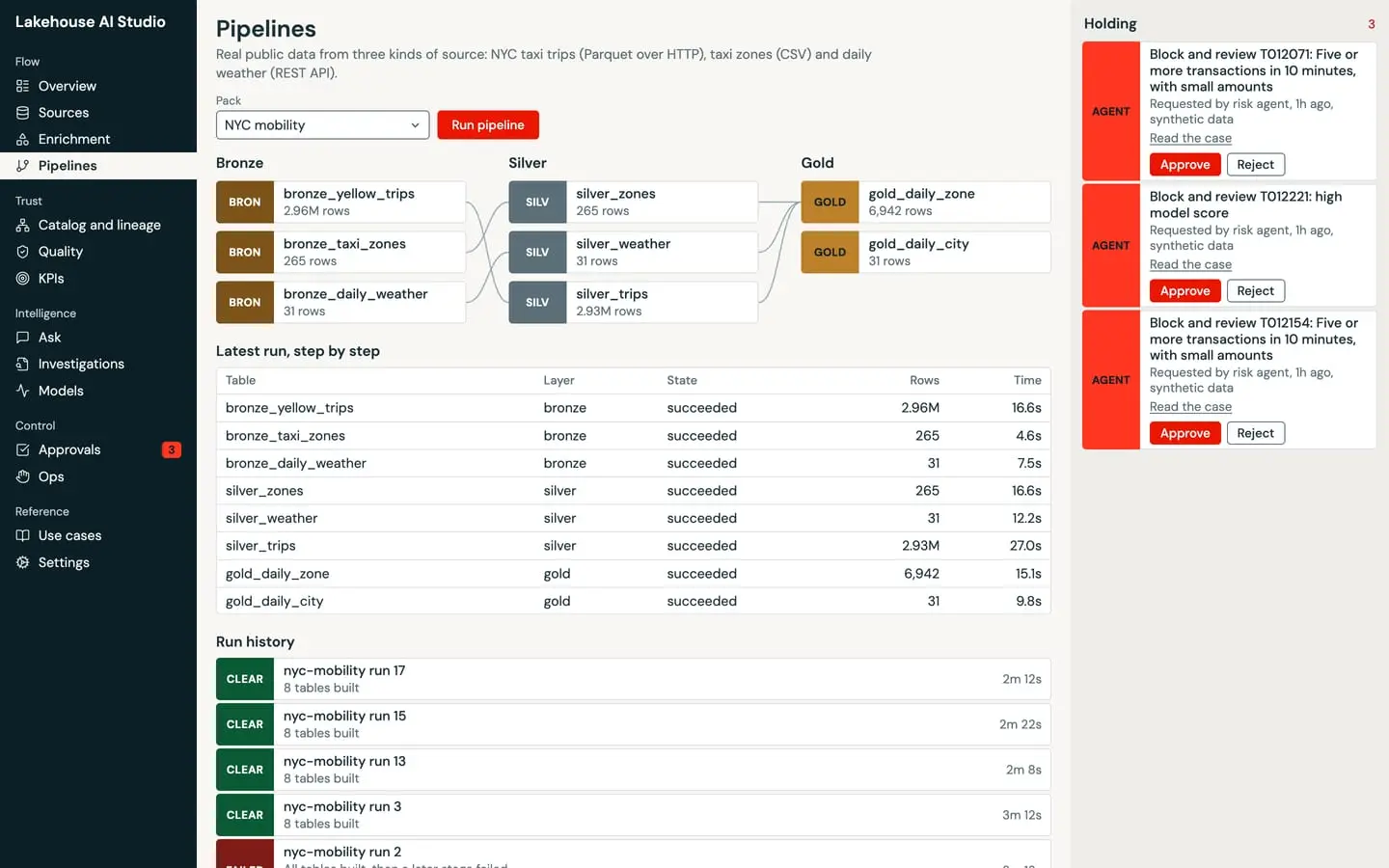
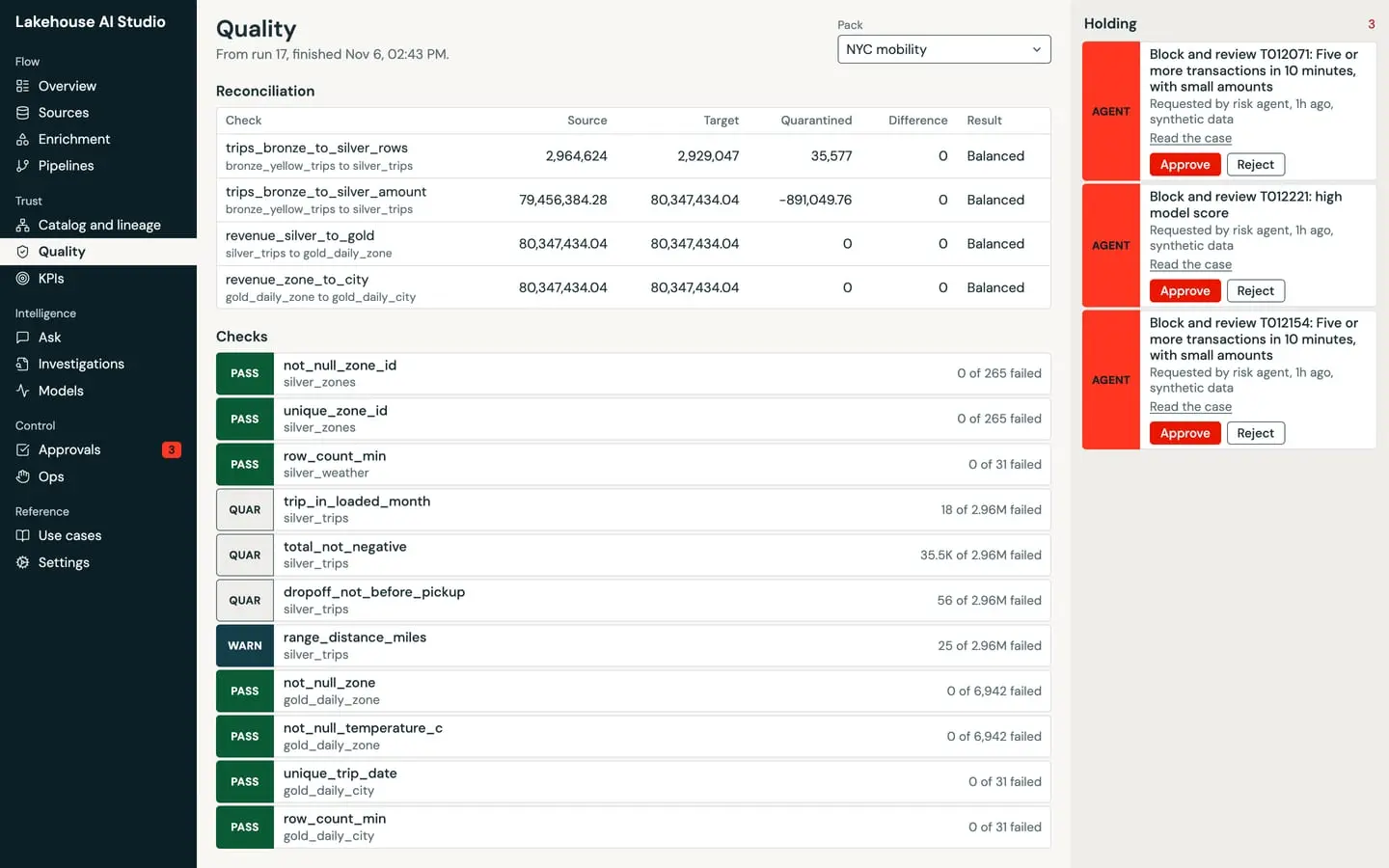
Data quality. Checks run between layers; about 35,000 bad rows of the 2.96M trips went to quarantine instead of into the numbers, and each quarantined row shows why it was held. Reconciliation accounts for every row and every dollar between layers, and lineage is recorded per table from the pack declarations.
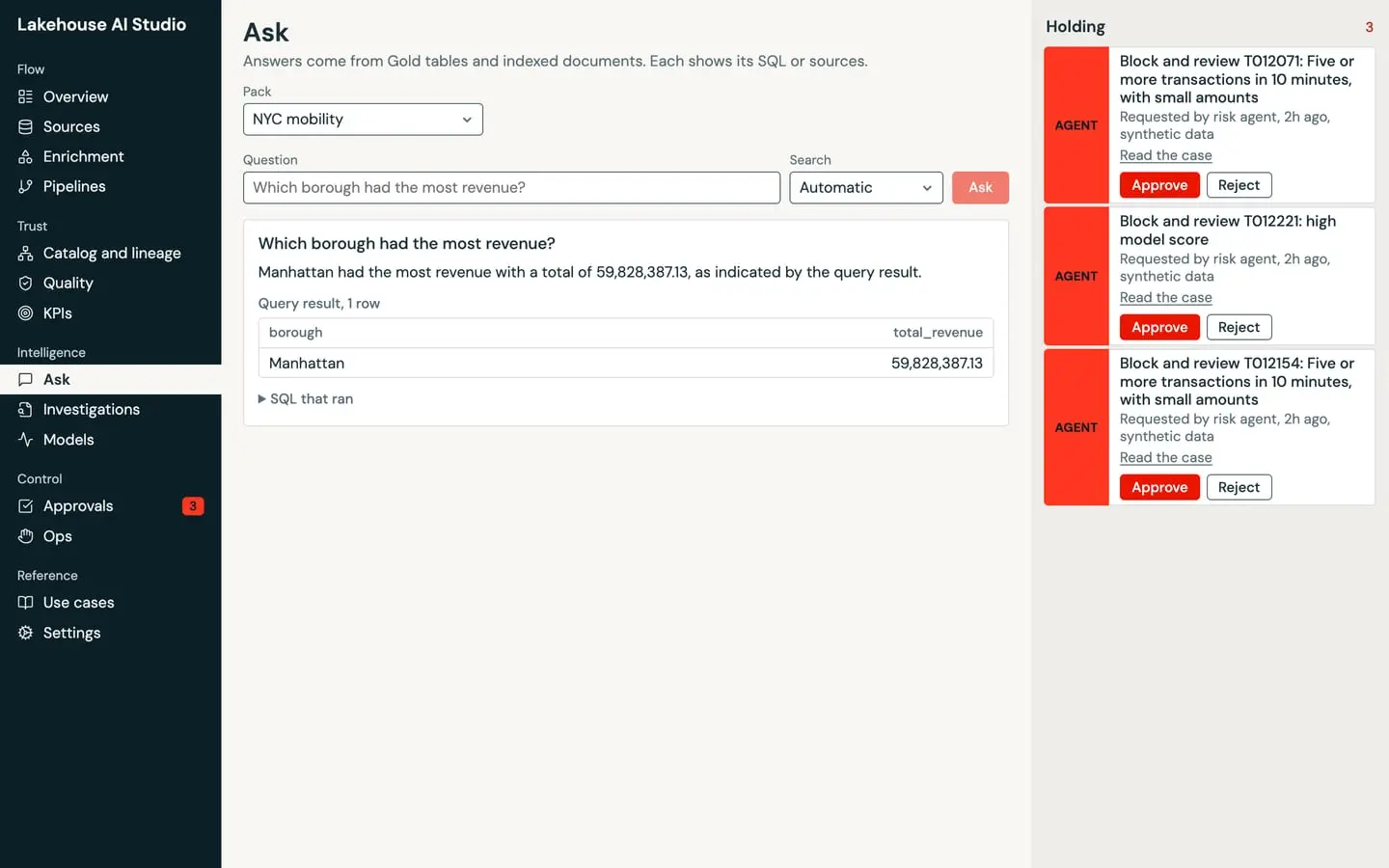
Ask. A plain-English question such as "which borough had the most revenue?" is answered with the real result and the SQL behind it, generated only over gold tables and passed through the SQL guard: read-only, approved tables only, personal-data columns refused, a forced row limit. Questions about documents ("what does payment type 3 mean?") run as RAG over PDFs indexed in pgvector, and the answer opens its source.
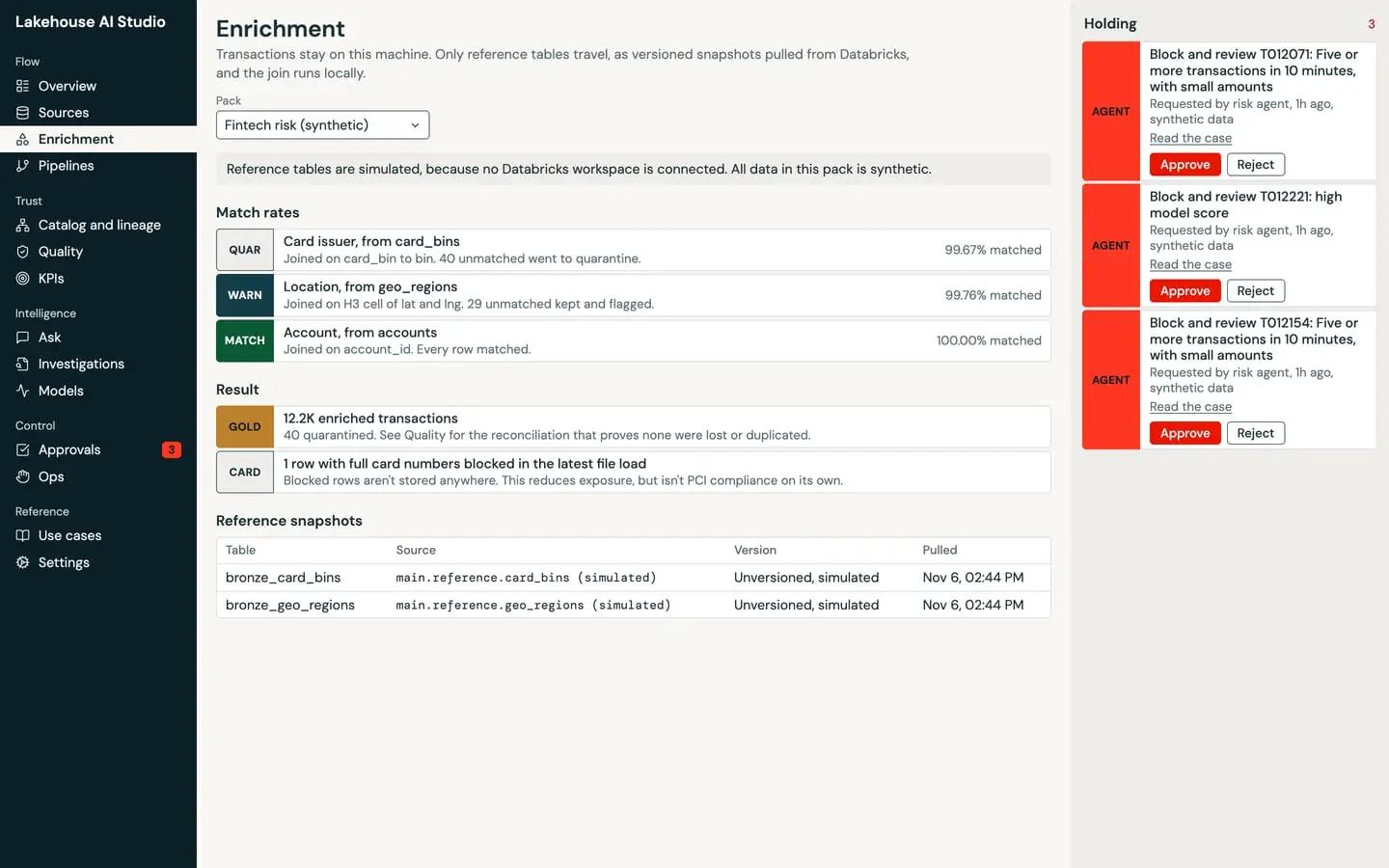
Hybrid enrichment. The fintech pack joins local transactions with card and location reference data pulled from Databricks tables as versioned snapshots, shows match rates per source, and blocks full card numbers at ingestion so blocked rows are never stored. The transactions are synthetic and the reference tables are simulated until a workspace is connected, and the interface says so.
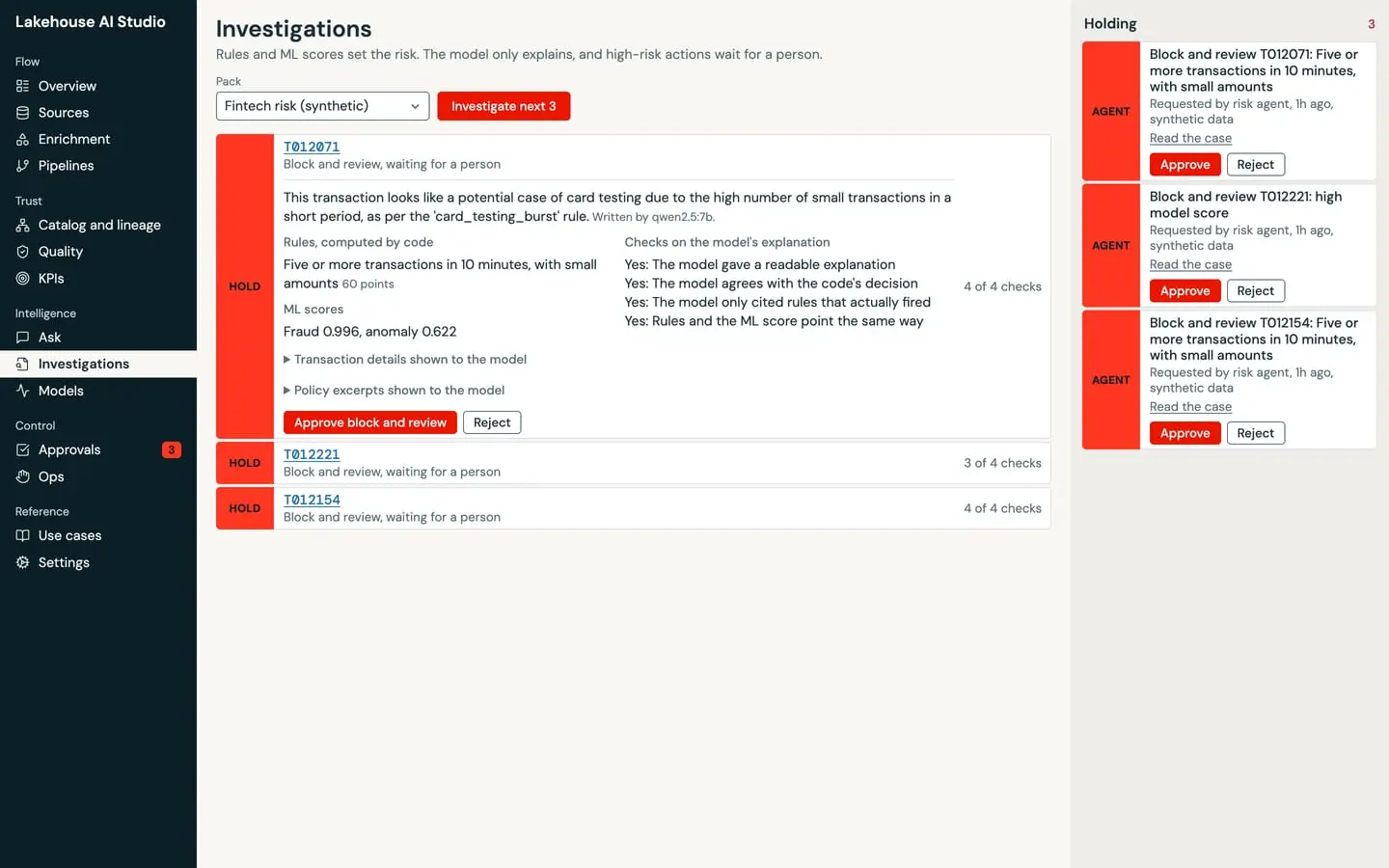
AI agents with human approval. A LangGraph flow investigates each fraud case: code computes the rules, the scores and the risk level, the model only explains them, and trust checks flag any disagreement between the two. High-risk actions go to an approvals inbox; a person approves or rejects, and the decision lands in an audit log that rejects updates and deletes at the database level.
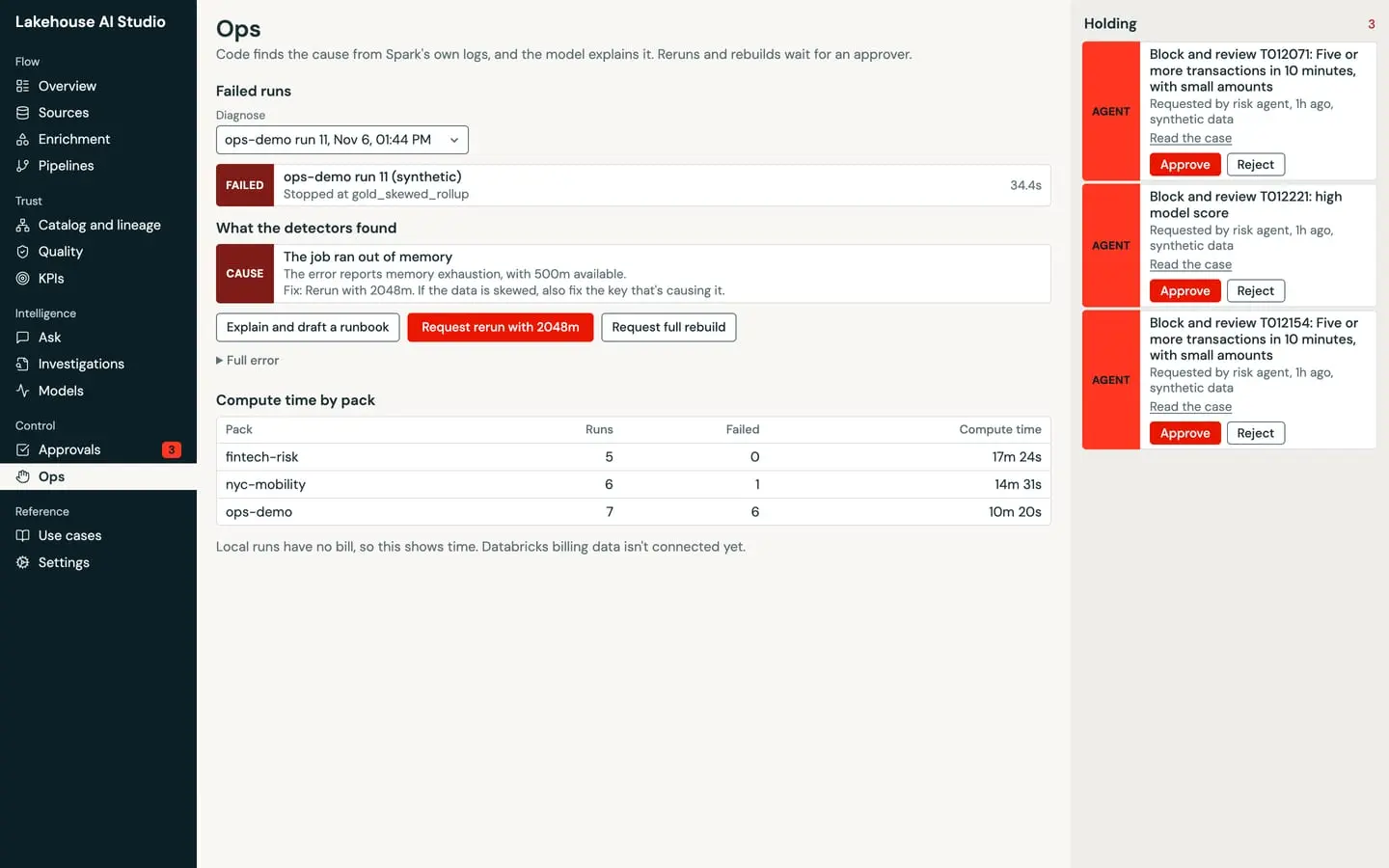
Failure diagnosis. The ops pack runs a job that really runs out of memory. The ops copilot finds the cause in Spark's event logs, drafts a runbook, and requests a rerun; the rerun waits for an approver and then succeeds.
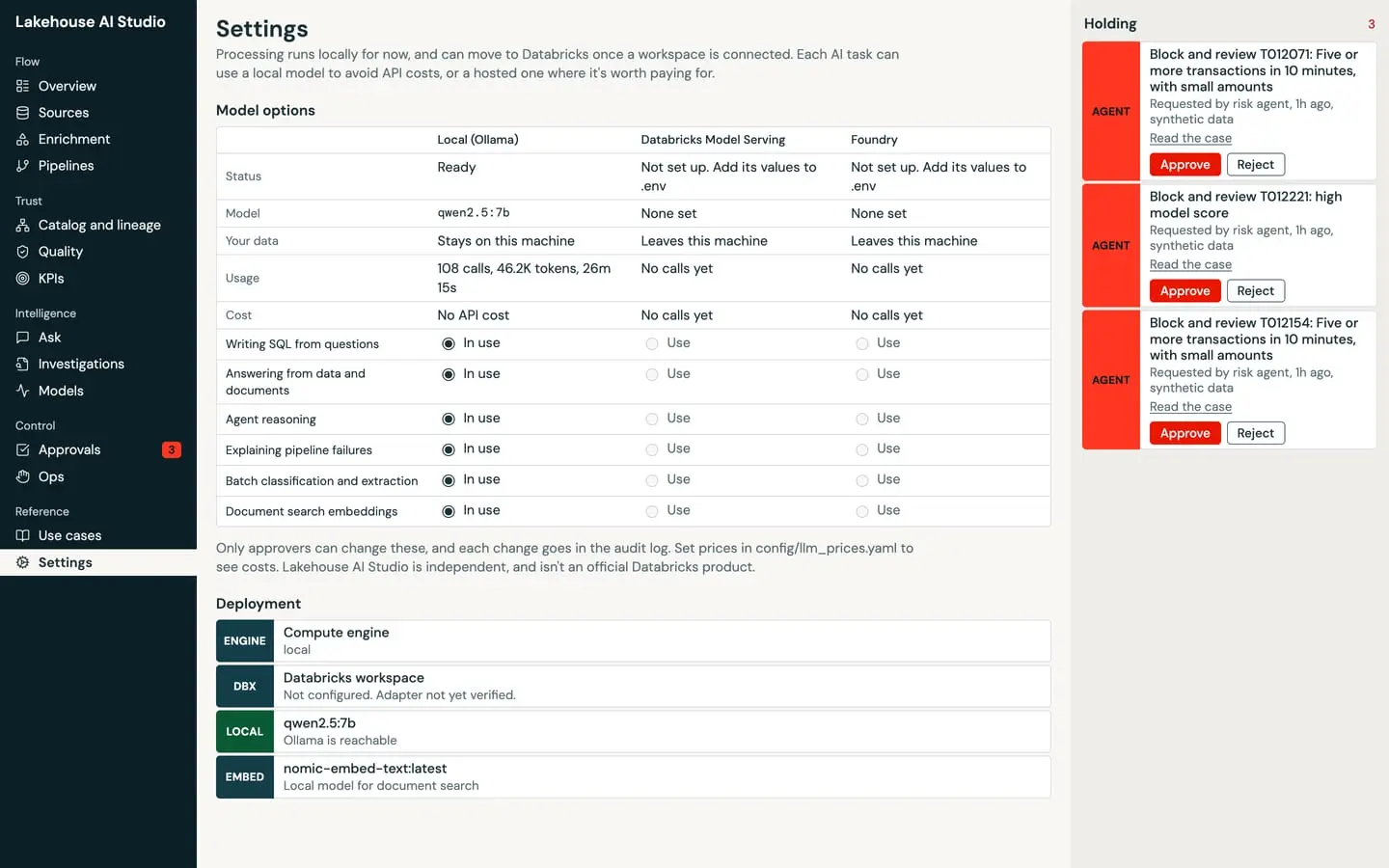
Model options. Settings shows one column per model option, local Ollama, Databricks Model Serving or Microsoft Foundry, with usage per task. An approver assigns a model to each task, and sending a task's data to a hosted model needs explicit confirmation, so API costs and data exposure are decided per task rather than once for the whole platform.
Safety rules the code enforces
Code computes rules, scores and risk, and the model cannot lower a risk level. High-risk actions, reruns, backfills and KPI promotions wait for an approver. The audit log rejects updates and deletes at the database level. Full card numbers are blocked at ingestion, which reduces exposure but is not PCI compliance on its own. Columns tagged as personal data are refused by the SQL guard and masked in samples. Local DuckDB queries can read the lake and nothing else on the machine. Every AI answer shows its SQL or its sources, and simulated, unverified and stale states are always visible in the interface.
Architecture
Sources (cloud files, HTTP, REST, JDBC, local files, Databricks tables, Delta Shares, PDFs) feed bronze, silver and gold built with PySpark and Delta from a pack's YAML and Spark SQL, with checks, quarantine, reconciliation, lineage and card-number blocking between the layers. Gold tables feed the guarded text-to-SQL, gold features feed the ML model tracked in MLflow, and documents feed pgvector search; all three feed the agents, which hand consequential actions to human approval and the audit log. A model router picks a provider per task, local Ollama, Databricks Model Serving or Foundry, and logs every call with its tokens and time. A React and TypeScript front end on Vite talks to a FastAPI backend; Postgres with pgvector holds the application state and the document index; the job runner is a separate process. One make setup creates the environment and secrets, make api and make web run it, and make demo checks the whole demo path against a running API.
What is and is not verified
Local mode is tested end to end, with 88 backend tests and AI evals per pack. The Databricks adapters, Microsoft Foundry and Delta Sharing are built and tested only against fakes until they are connected to real services; the Databricks Asset Bundle is included but has not been run on a live workspace yet, and the interface labels the adapter as unverified until it is. Streaming means micro-batches over a folder, there is no Kafka or Event Hubs source, and lineage is table-level from the pack declarations rather than read from Unity Catalog. The companies in the use-case catalog are market references from Databricks' published summit post, never customers of this product.
Related projects
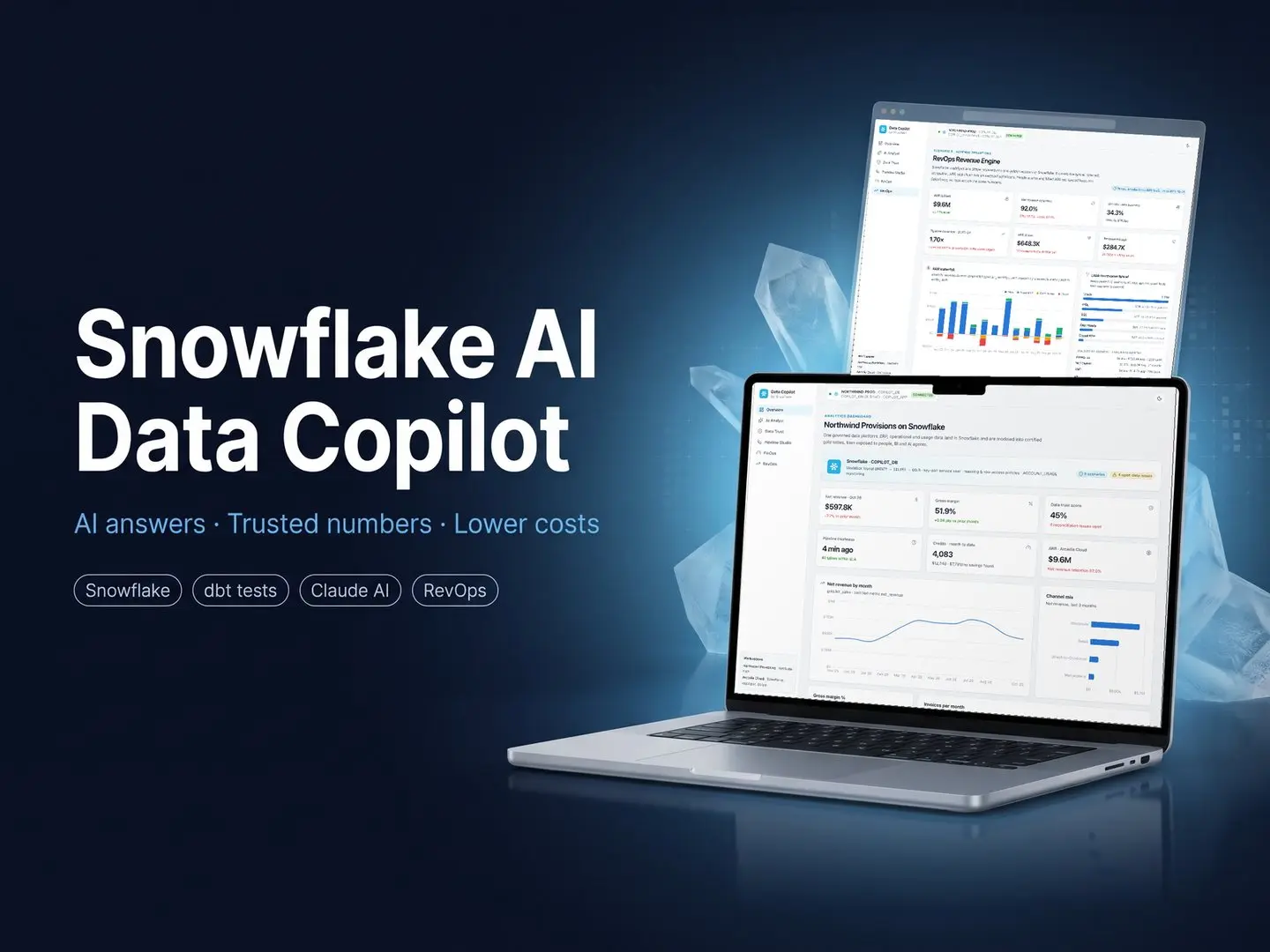
Snowflake AI Data Copilot: Trusted Numbers, AI Answers, Lower Costs
Databases & Data Engineering · AI & Agents · Cloud, DevOps & LLMOps
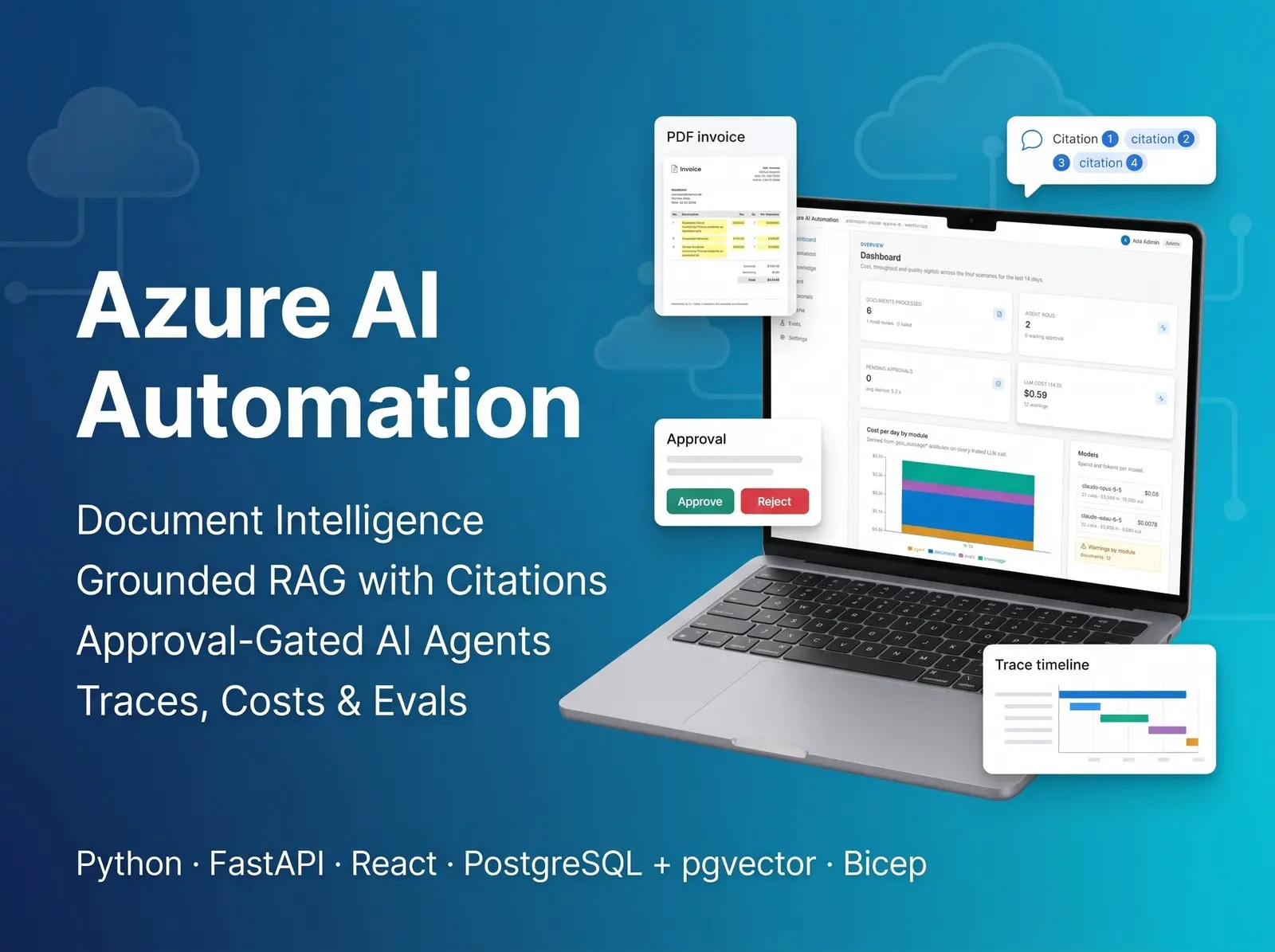
Azure AI Automation: Document Intelligence, RAG & Governed Agents
AI & Agents · Cloud, DevOps & LLMOps · Databases & Data Engineering
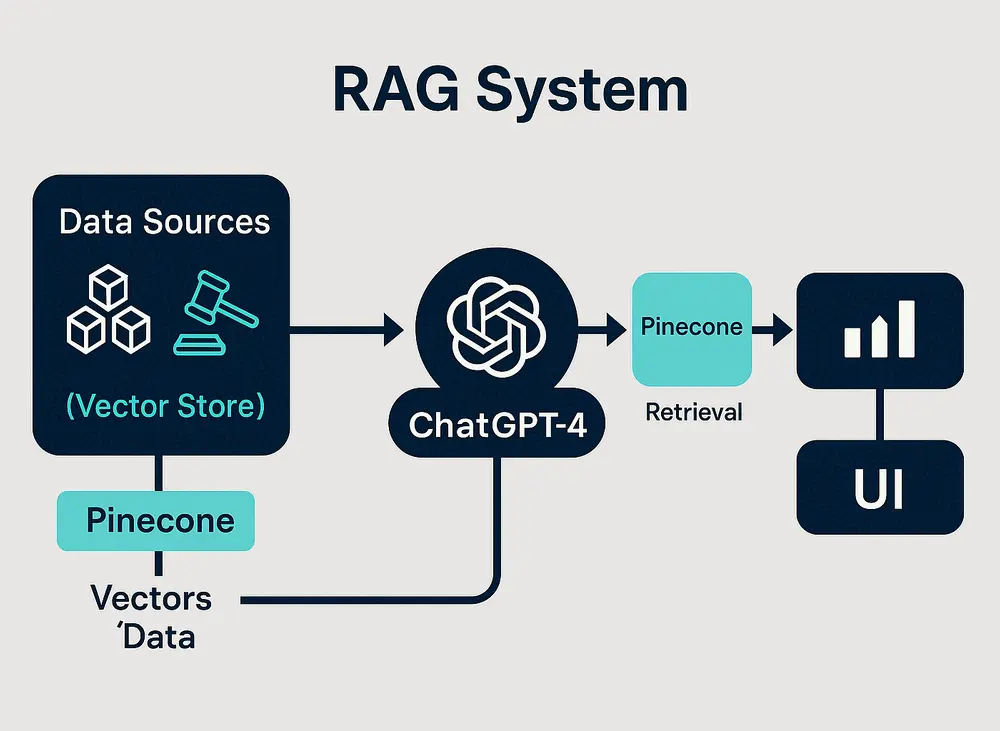
Crypto Regulation RAG Chatbot (GPT-4 + Pinecone)
AI & Agents · Databases & Data Engineering · Cloud, DevOps & LLMOps