Computer Vision & Generative Media · Data Science & ML · Cloud, DevOps & LLMOps
Computer Vision with YOLO26/27: Three Edge-Ready Demos
By David Gadyan · Published
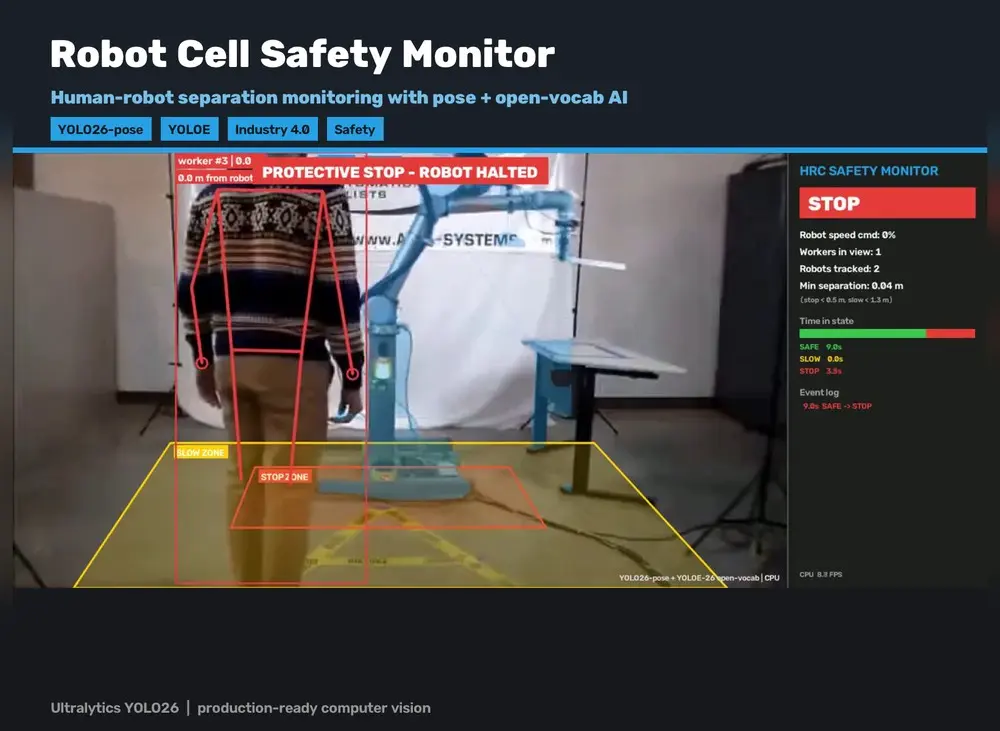
Three production-style computer-vision demos on Ultralytics YOLO26, all running in real time on a laptop CPU: an AI workout monitor that counts reps and gives form cues from pose estimation, a drone parking-occupancy system on oriented bounding boxes with drift compensation, and a human-robot safety monitor that combines pose with open-vocabulary segmentation. Each one exports to Raspberry Pi, the Pi AI Camera, Jetson or mobile.
The problem
Three briefs that come up again and again in computer-vision work: fitness apps and connected gyms need rep counting and form feedback from an ordinary camera, parking operators want live occupancy without $200–400 in-ground sensors per space, and factories need to know how close people get to robots that have left their cages. All three were built on the same YOLO26 toolkit, run in real time on a laptop CPU, and export to cheap edge hardware.
What I built
AI workout monitor: rep counting and form feedback
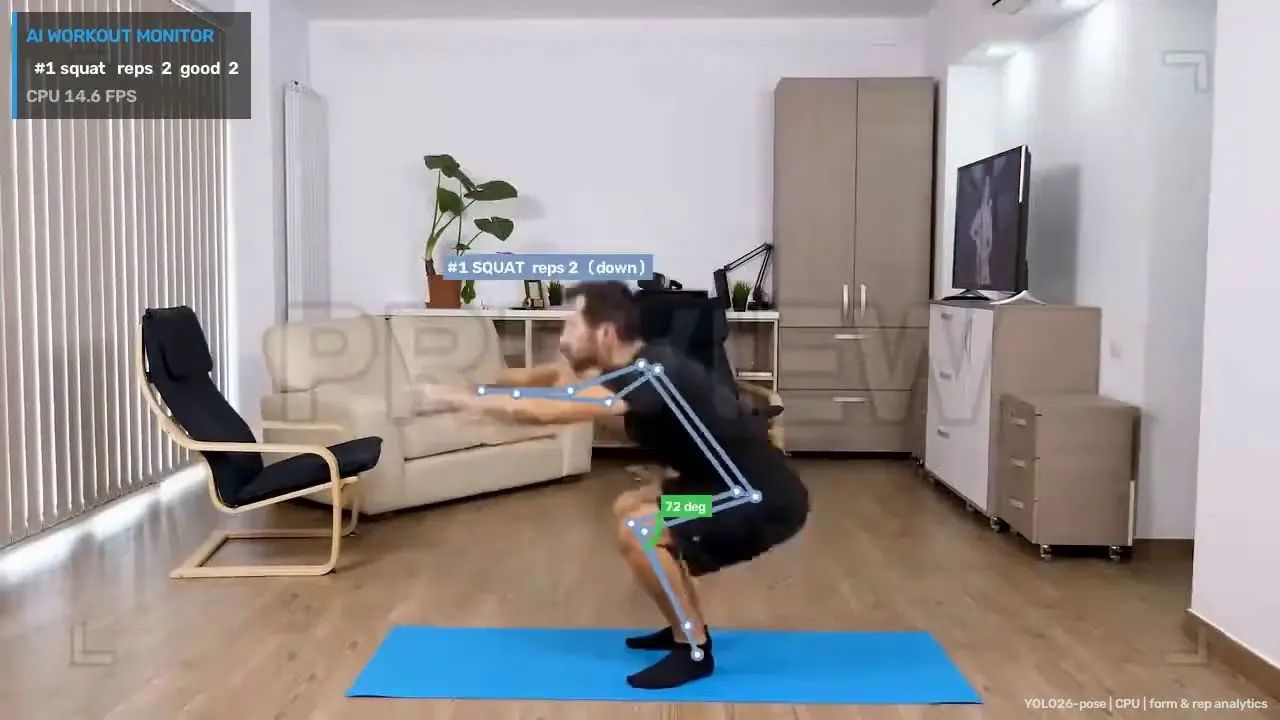
YOLO26-pose gives 17 keypoints per person in one pass and ByteTrack keeps a stable ID per athlete, so each person in a group gets their own counter. A joint-angle engine (knee, elbow, hip, body line) reads whichever side the camera sees better. The exercise is detected automatically: a horizontal torso means push-up, a moving knee means squat, a moving elbow with static knees means curl. A per-exercise hysteresis state machine separates full-range reps from partial ones, and form rules produce cues such as "Go deeper" or "Keep body straight". Mirror reflections and background people are filtered out. Each session writes a JSON report with reps, full-range reps, a form score and the issues raised.
Rep counting, auto-detected exercises and live cues (25 s):
Drone smart parking: slot occupancy from aerial video
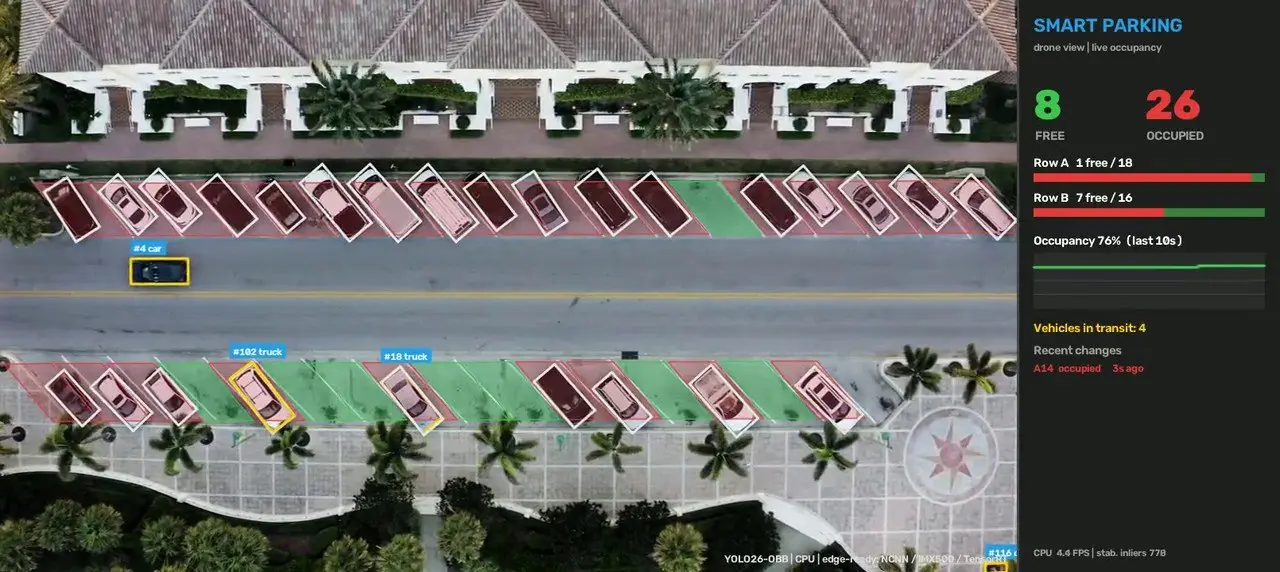
Top-down cars are rotated and densely packed, which defeats axis-aligned detectors, so this one uses YOLO26-OBB, pre-trained on aerial imagery, for tight rotated boxes. A whole row of angled spaces is six numbers in a YAML file. ORB features matched against a reference frame plus a RANSAC homography warp the slot map every few frames, so it follows the drifting drone: without it, misalignment produced 32 false slot events in 35 seconds, with it 3. An asymmetric debounce needs 1.5 s of evidence before a slot is called free and 0.3 s before it is called occupied, because a dark car missed in shadow is far more common than a phantom car. Occupancy uses the fraction of the slot that is covered rather than IoU, so vans bigger than the slot still count. The device publishes a few bytes of JSON per minute.
Drone pass with the live dashboard (20 s):
Robot cell safety monitor: human-robot separation
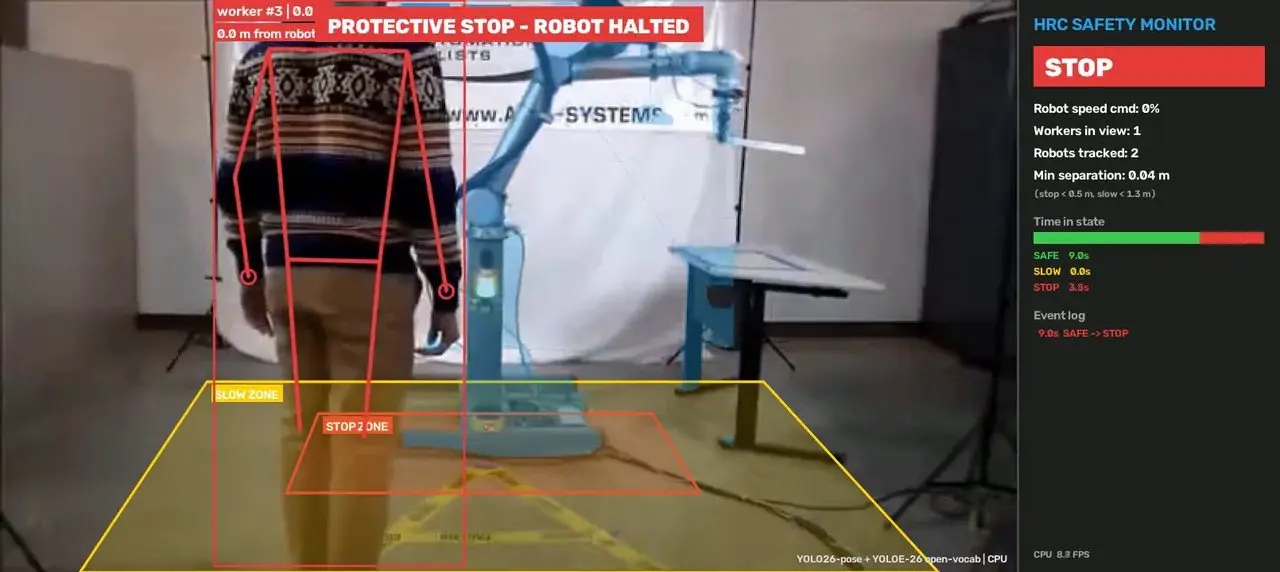
Laser scanners only see an ankle-height slice; this monitor adds hand-level awareness from a single camera. YOLO26-pose tracks the workers and YOLOE-26 segments the robots from text prompts ("robot arm", "collaborative robot"), with negative prompts so people are never labelled as robots and with no robot dataset at all. A distance transform gives the pixel distance from any of 12 body keypoints, wrists included, to the robot mask, converted to metres using the worker's own torso as a scale. Floor zones, a hysteresis state machine (escalate immediately, release after one second) and a person-down detector drive a recommended robot speed of 100, 30 or 0 % and a timestamped event log ready for a PLC, OPC UA or MQTT. If a worker blocks the camera's view of the robot, the last robot mask is kept for six seconds so the robot is never forgotten. It is designed as a decision-support and near-miss analytics layer next to certified safety devices, not as a safety function on its own.
UR10 cell going SAFE → STOP → SLOW → STOP → SAFE, then a cobot assembly line (24 s):
How it was delivered
The three projects share one small toolkit (video I/O, drawing, registration, zones and a training script), so a new demo is mostly a run script and a YAML file. YOLO26 is NMS-free end to end, which is what makes the exported graphs clean enough for NPUs: the parking model was exported and benchmarked to ONNX, NCNN (Raspberry Pi 4/5) and OpenVINO (Intel IPCs), packaged for the Sony IMX500 on the Raspberry Pi AI Camera, with a TensorRT FP16 path for Jetson. The workout monitor exports to TFLite, CoreML and NCNN for on-device mobile apps, so video never leaves the phone. Frame rates were measured on an i9 laptop CPU while two training jobs shared the same CPU: about 15 FPS for the workout monitor at 1280×720, 5.5 FPS for parking at 1024 px including stabilisation and dashboard, and about 9 FPS for the safety monitor running two models per frame.
Outcome
Three working demos with annotated videos, per-session JSON reports and edge export paths, published with the code on GitHub. Each one is a configuration change away from a new use case: another exercise is one rule entry, another parking lot is a slot file and a reference frame, another robot cell is a YAML with prompts, thresholds and floor polygons. The demo clips are short excerpts of public YouTube videos used for technical demonstration.
Related projects
Visual Product Search with Google Vision AI
Computer Vision & Generative Media · Cloud, DevOps & LLMOps

Document OCR & Data Extraction API
Computer Vision & Generative Media · Cloud, DevOps & LLMOps

Driver Fatigue Detection on Edge Devices
Computer Vision & Generative Media · Cloud, DevOps & LLMOps