
Cloud Architecture
Azure, Fabric, Databricks or Foundry: Which Microsoft Service to Choose?
By David Gadyan · Published · 22 min read
A client who runs on Microsoft 365 asks which Azure service to use for data and AI. The answer is four products with one job each: Azure is the cloud, Microsoft Fabric the analytics platform, Azure Databricks the Spark and ML lakehouse, Microsoft Foundry the platform for LLM apps and agents. This post compares them in tables, maps them to AWS and Google Cloud, and ends with a decision guide.
Over the past two weeks I compared Snowflake with Databricks, turned a Databricks course into an interactive mind map and shipped an Azure document-intelligence automation. The question that followed each time came from companies that already run on Microsoft: which Azure service do we actually need: Fabric, Databricks or Foundry?
This post answers it in three steps: why a company picks Azure over AWS or Google Cloud, what each Microsoft platform is for, and which combinations work in real AI projects. Every product name was checked against Microsoft Learn, the AWS documentation and the Google Cloud release notes on 6 November 2026. The names change often, so the sources at the end carry the current state.
The short answer. Azure is the cloud. Microsoft Fabric is the SaaS platform for data engineering, analytics and BI. Azure Databricks is the lakehouse for large-scale Spark, Delta Lake and machine learning. Microsoft Foundry is the platform for LLM applications and AI agents. Azure AI Search is the retrieval layer and Azure Machine Learning the classic ML lifecycle. They complement each other, and none of them replaces Azure.
Why would a company choose Azure over AWS or Google Cloud?
A company chooses Azure when its identity, documents and reporting already live with Microsoft. Microsoft Entra ID handles the logins, Microsoft 365 and SharePoint hold the documents, Teams is where people work and Power BI is where the numbers are read. An AI project on Azure plugs into that estate with managed identities and one governance model instead of federating three clouds.
Service by service, the three clouds do comparable jobs. This table maps the core Azure services to their AWS and Google Cloud counterparts.
| Category | Azure | AWS | Google Cloud |
|---|---|---|---|
| Virtual machines | Azure Virtual Machines | EC2 | Compute Engine |
| Object storage | Blob Storage, ADLS Gen2 | S3 | Cloud Storage |
| Data warehouse | Fabric Warehouse (Synapse before it) | Redshift | BigQuery |
| Kubernetes | AKS | EKS | GKE |
| Serverless functions | Azure Functions | Lambda | Cloud Functions |
| Serverless containers | Container Apps | ECS on Fargate | Cloud Run |
| Managed SQL | Azure SQL | RDS | Cloud SQL |
| Networking | Virtual Network | VPC | VPC |
| Identity | Entra ID | IAM | IAM |
| Secrets | Key Vault | Secrets Manager | Secret Manager |
| Monitoring | Azure Monitor | CloudWatch | Cloud Monitoring |
| Document OCR | Document Intelligence | Textract | Document AI |
The jobs match; the pricing, the architecture, the integrations and the limits do not. Choose the cloud for the estate you have and the skills your team has, then map the services with a table like this one.
What pulls a company towards Azure, and what each pull gives an AI project:
| Pull towards Azure | What it gives an AI project |
|---|---|
| Microsoft Entra ID | Users, groups, managed identities and RBAC reused by Foundry, Fabric, Databricks and AI Search |
| Microsoft 365, SharePoint, Teams | The documents and conversations most enterprise assistants need to read |
| Power BI | The reporting layer business users already open; Fabric feeds it through Direct Lake |
| Microsoft Foundry | More than 10,000 models from Microsoft, OpenAI, Anthropic, Meta and others in one catalog under Azure governance |
| An existing enterprise agreement | One bill, one support contract, one compliance review |
What is the difference between Azure, Microsoft Fabric, Azure Databricks and Microsoft Foundry?
They sit at different levels. Azure is the infrastructure: compute, storage, networking and identity. Microsoft Fabric and Azure Databricks are data platforms that run on that infrastructure. Microsoft Foundry is an AI application platform that runs on it too. Azure AI Search and Azure Machine Learning are specialised services beside them. Every one of them is complementary; the mistake is to treat Foundry as a replacement for Databricks or Fabric.
| Platform | Main responsibility | Built for | AWS equivalent | Google Cloud equivalent |
|---|---|---|---|---|
| Microsoft Azure | Cloud infrastructure: compute, storage, networking, identity, security | Everyone | AWS | Google Cloud |
| Microsoft Fabric | Data engineering, analytics, lakehouse and BI as one SaaS | Analysts, BI developers, data engineers | Redshift with the Glue ecosystem | BigQuery |
| Azure Databricks | Large-scale data engineering, Spark, Delta Lake, ML, lakehouse | Data engineers, ML engineers, data scientists | Databricks on AWS, EMR | Databricks on Google Cloud, Dataproc |
| Microsoft Foundry | AI applications, LLMs, agents, evaluation, governance | AI engineers, application teams | Amazon Bedrock | Gemini Enterprise Agent Platform |
| Azure Machine Learning | Classic ML lifecycle: training, registry, deployment | Data scientists, MLOps | SageMaker AI | Gemini Enterprise Agent Platform (formerly Vertex AI) |
| Azure AI Search | Enterprise search, hybrid and vector retrieval | RAG and search applications | OpenSearch | Agent Search (formerly Vertex AI Search) |
What is Microsoft Foundry?
Microsoft Foundry is Microsoft's platform for building, deploying, managing and monitoring AI applications and AI agents, built on Azure. It was called Azure AI Studio, then Azure AI Foundry; Azure AI Services became Foundry Tools. Foundry unifies agents, models and tools in one Azure resource with tracing, evaluations, role-based access control, networking and policies.
What you do in Microsoft Foundry:
- Models. Browse and deploy more than 10,000 models from Microsoft, OpenAI, Anthropic, Meta and others from the Foundry Models catalog, with fine-tuning where the model supports it.
- Agents. Build declarative prompt agents in the portal or the SDK, or hosted agents that run your own code (Microsoft Agent Framework, LangGraph, Semantic Kernel) as a container with a managed endpoint, all in Foundry Agent Service.
- Tools and knowledge. Extend agents with built-in tools, memory and retrieval through the Foundry Toolbox; Foundry IQ (preview) is the knowledge layer that connects enterprise sources.
- Evaluation and observability. Trace and evaluate agents and models, and monitor them in built-in dashboards.
- Governance. Entra identity, RBAC, content filters, network isolation and Azure Policy through the Foundry control plane.
A worked example: an enterprise RAG chatbot over company PDFs.
- Upload the PDFs to Blob Storage.
- Extract the text and tables with Document Intelligence.
- Clean, transform and chunk the documents in Azure Databricks.
- Generate embeddings with a Foundry model.
- Store the vectors in Azure AI Search.
- Retrieve the relevant chunks for each question.
- Send the context to an LLM in Foundry and generate an answer with citations.
Foundry manages the model, the agent, the evaluation and the deployment parts of this workflow. Storage, extraction, data processing, networking and identity stay on other Azure services. Foundry does not replace Azure; it is one layer within the Azure architecture.
How does Microsoft Foundry compare with Amazon Bedrock and Gemini Enterprise Agent Platform?
They are the closest equivalents in the three clouds: functional matches, not one-to-one replacements. Amazon Bedrock is the AWS managed generative AI platform; Gemini Enterprise Agent Platform is the Google Cloud AI and agent platform that Vertex AI became part of on 22 April 2026.
| Capability | Microsoft Foundry | Amazon Bedrock | Gemini Enterprise Agent Platform |
|---|---|---|---|
| Model catalog | Foundry Models | Bedrock models | Model Garden |
| LLM inference | Foundry Models | Bedrock Runtime | Gemini models |
| AI agents | Foundry Agent Service: prompt and hosted agents | Bedrock Agents, AgentCore runtime | Agent Runtime (formerly Agent Engine) |
| RAG | Foundry IQ and retrieval tools, Azure AI Search | Knowledge Bases | RAG Engine, Vector Search, Agent Search |
| Fine-tuning | Foundry Models | Bedrock model customization | Model tuning |
| Evaluation | Foundry evaluations and tracing | Bedrock evaluations | Evaluation service |
| Governance | Foundry control plane, Entra ID | Guardrails and IAM | Model Armor and IAM |
| Bring your own agent code | Hosted agents in containers | AgentCore runtime | Agent Runtime with the ADK or LangGraph |
Which product names changed in 2025 and 2026?
Several of the names in these tables are less than a year old, and the old ones still appear in documentation, job posts and tutorials. This glossary maps the previous name to the current one so that the rest of the post reads the same way the vendors' pages do.
| Previous name | Current name | Vendor |
|---|---|---|
| Azure AI Studio, Azure AI Foundry | Microsoft Foundry | Microsoft |
| Azure AI Services | Foundry Tools | Microsoft |
| Assistants API (Agents v1) | Responses API (Agents v2) | Microsoft |
| Azure Synapse Analytics | Microsoft Fabric: Data Warehouse and Data Engineering | Microsoft |
| Azure Data Factory | Data Factory in Fabric; the Azure service still exists | Microsoft |
| Vertex AI | Part of Gemini Enterprise Agent Platform since 22 April 2026 | Google Cloud |
| Vertex AI Agent Engine | Agent Runtime | Google Cloud |
| Vertex AI Search | Agent Search | Google Cloud |
| Vertex AI RAG Engine, Vector Search, Model Garden | RAG Engine, Vector Search, Model Garden | Google Cloud |
| Amazon SageMaker | SageMaker AI for the ML service; SageMaker is now the unified data and AI platform | AWS |
| Bedrock Agents | Bedrock Agents, with the AgentCore runtime for new agents; Bedrock Guardrails apply to AgentCore policies since June 2026 | AWS |
What is Microsoft Fabric?
Microsoft Fabric is Microsoft's unified SaaS platform for collecting, storing, processing, analysing and visualising data. Instead of configuring a data lake, a warehouse, ETL pipelines, Spark clusters and a BI tool separately, Fabric delivers them as workloads over one logical lake, OneLake, with Power BI as the reporting layer. Microsoft Learn adds a detail that surprises Azure engineers: you do not need an Azure account to use Fabric.
| Fabric workload | What it does | Similar technology |
|---|---|---|
| OneLake | The tenant-wide logical data lake every workload reads and writes | ADLS Gen2, S3, Cloud Storage |
| Data Factory | Ingestion, pipelines and Dataflow Gen2 with more than 200 connectors | Azure Data Factory, AWS Glue |
| Data Engineering | Apache Spark notebooks and jobs, lakehouses | Databricks, EMR, Dataproc |
| Data Warehouse | SQL analytics over Delta tables, compute separate from storage | Snowflake, Redshift, BigQuery |
| Data Science | ML experiments and models, integrated with Azure Machine Learning | Databricks ML, SageMaker AI |
| Real-Time Intelligence | Streaming ingestion, KQL databases and the Real-Time hub | Kinesis, Pub/Sub, Event Hubs |
| Databases | SQL database in Fabric, plus mirroring of Azure SQL, Cosmos DB, Azure Databricks and Snowflake into OneLake | Azure SQL, RDS |
| Power BI | Reports and dashboards, Direct Lake over OneLake | Tableau, Looker |
| Fabric IQ (preview) | Ontology, Fabric Graph, data agent, operations agent, semantic models | Semantic layers |
| OneLake Catalog and Purview | Discovery, permissions, sensitivity labels, audit | Unity Catalog, Dataplex |
What is OneLake?
OneLake is the single logical data lake every Fabric tenant gets, built on Azure Data Lake Storage Gen2. Think of OneDrive for enterprise analytics data: one namespace that spans users, regions and clouds, organised in workspaces, lakehouses and warehouses, read by every Fabric workload without copies. Tables are stored as Delta Parquet, and OneLake exposes Iceberg metadata for Delta tables so that Iceberg readers see them without copying data.
Microsoft Fabric tenant
└── OneLake
    ├── Workspace: Finance
    │   ├── Lakehouse
    │   └── Warehouse
    ├── Workspace: Marketing
    │   └── Lakehouse
    └── Workspace: AI Projects
        └── Lakehouse
Two OneLake features matter for architecture. Shortcuts mount existing storage, including ADLS Gen2, Amazon S3 and Google Cloud Storage, as zero-copy references inside the lake. Mirroring replicates Azure SQL, Cosmos DB, Azure Databricks Unity Catalog and Snowflake into OneLake, so Fabric can read them without a pipeline.
How would you build a data pipeline in Fabric?
Take an e-commerce company that receives data from a Shopify API, PostgreSQL, Salesforce, SharePoint and CSV files, and wants one analytics platform.
- Create a Fabric workspace and a lakehouse inside it.
- Ingest the sources with Data Factory connectors on a schedule.
- Land the raw data as bronze tables in the lakehouse.
- Clean and deduplicate into silver tables with PySpark notebooks.
- Aggregate into business-ready gold tables and query them in SQL from the warehouse endpoint.
- Build the Power BI dashboard on the gold tables, and connect the same tables to a Microsoft Foundry agent for questions in natural language.
This is the medallion architecture Databricks popularised. Fabric supports the same bronze, silver and gold pattern on the same Delta format.
Microsoft Fabric vs Azure Databricks: what is the real difference?
Both run distributed Apache Spark on Delta Lake tables. The difference is who they are built for and how much control they give you. Microsoft Fabric is a managed SaaS with Power BI inside, built for business analysts, data analysts, data engineers and BI developers. Azure Databricks is an engineering and AI platform with configurable compute, MLflow and Mosaic AI, built for data engineers, ML engineers, data scientists and AI engineers.
| Area | Microsoft Fabric | Azure Databricks |
|---|---|---|
| Infrastructure | Managed SaaS, governed by Fabric capacity | Managed platform inside your Azure subscription |
| Spark | Fabric Spark on managed compute | Databricks Runtime on clusters you configure |
| SQL | Fabric Warehouse and SQL endpoints | Databricks SQL warehouses |
| Storage | OneLake | Your own ADLS Gen2 (or S3, Cloud Storage) |
| Table format | Delta Lake | Delta Lake |
| ETL and orchestration | Data Factory pipelines | Lakeflow jobs and pipelines |
| Machine learning | Data Science workload, integrated with Azure Machine Learning | MLflow, Mosaic AI, model serving |
| BI | Power BI, native, with Direct Lake | AI/BI Dashboards; Power BI through a connector |
| Applications | Power BI and Microsoft 365 integrations | Databricks Apps |
| Governance | OneLake Catalog and Microsoft Purview | Unity Catalog |
| Compute control | Capacity, Spark autoscale, environments | Node types, cluster sizes, GPU clusters, Spark settings |
| Clouds | Azure, with OneLake shortcuts to S3 and Cloud Storage | Azure, AWS and Google Cloud |
The same comparison as yes-or-no questions, which is how the question usually arrives:
| Can it... | Microsoft Fabric | Azure Databricks |
|---|---|---|
| Process massive datasets with distributed Spark? | Yes | Yes |
| Run PySpark with multiple workers and autoscaling? | Yes, managed by capacity | Yes, configurable |
| Build ML models? | Yes | Yes |
| Build AI applications? | Yes, with Microsoft Foundry | Yes, with Mosaic AI |
| Build web applications? | Through integrations | Yes, Databricks Apps |
| Serve native business dashboards? | Power BI | AI/BI Dashboards |
| Integrate with enterprise BI? | Very strong | Usually an external BI tool |
| Tune Spark and GPU compute in detail? | More managed, capacity constraints | More flexible |
Choose Microsoft Fabric when the company uses Microsoft 365, Power BI and SharePoint; the workloads are mainly SQL analytics and business reporting; you want data engineering and BI in one managed environment; and nobody on the team wants to size a Spark cluster.
Choose Azure Databricks when the work is large-scale Spark processing or complex distributed engineering; the team builds advanced ML and AI workloads; you need control over compute, node types and GPUs; or the architecture spans streaming and more than one cloud.
They also work together. Microsoft documents mirroring Azure Databricks Unity Catalog tables into OneLake as a read-only catalog with no data movement, generally available since 2025, and the reverse path, OneLake catalog federation, which lets Unity Catalog query data stored in OneLake from Databricks compute and was in Beta when I checked.
Is Fabric just Databricks without multiprocessing?
No. Fabric and Databricks both distribute work across Spark executors; neither relies on Python multiprocessing. The confusion comes from mixing two kinds of parallelism.
| Technology | How it parallelises | Where it runs |
|---|---|---|
| Python multiprocessing | Several local operating-system processes | One machine |
| Python threading | Several threads in one process | One machine |
| PySpark | Tasks distributed across Spark executors | A cluster |
| Azure Databricks | Distributed Spark workloads on clusters you configure | Your Azure subscription |
| Microsoft Fabric | Distributed Spark workloads on managed capacity | The Fabric SaaS |
A Pool(4) in Python starts four local processes and never touches a cluster:
from multiprocessing import Pool

def process(x):
    return x * 2

with Pool(4) as pool:
    results = pool.map(process, range(100_000))
On Fabric or Databricks the same intent is a DataFrame operation, and Spark decides which executor runs which partition:
df = spark.read.parquet("/path/to/data")
result = df.repartition(8).groupBy("category").count()
result.show()
Fabric is not a less powerful Databricks because it is more managed. Databricks offers more flexibility for advanced compute engineering; Fabric trades that flexibility for integration and simplicity across the Microsoft ecosystem.
How do the layers look in Azure, AWS and Google Cloud?
Every enterprise AI architecture has the same four layers: AI applications and agents on top, data engineering below, data storage under that, and cloud infrastructure at the bottom. Pick a cloud in the diagram and tap a layer to see which services fill it.
Microsoft Foundry on top, Microsoft Fabric or Azure Databricks in the middle, OneLake and ADLS Gen2 underneath, Azure infrastructure at the bottom.
Foundry Models serve the LLM, Foundry Agent Service runs the agent, Azure AI Search holds the vectors and the hybrid index that RAG retrieves from.
Fabric for managed SaaS pipelines, Spark and Power BI; Azure Databricks for large Spark jobs, Delta Lake and ML; Data Factory for ingestion from more than 200 connectors.
Object storage for files and Delta tables, OneLake as the logical lake every Fabric workload reads, a SQL warehouse for analytics, Azure SQL for transactions.
Compute, containers, serverless, networking, identity, secrets and monitoring: the part that neither Foundry nor Fabric replaces.
Typical use: A company that already runs Microsoft 365, Entra ID and Power BI and wants its AI agents next to that data.
Tap a layer to read what that technology does in this stack.
| Layer | Technology | What it does |
|---|---|---|
| AI applications and agents | Microsoft Foundry, Foundry Agent Service, Azure AI Search | Foundry Models serve the LLM, Foundry Agent Service runs the agent, Azure AI Search holds the vectors and the hybrid index that RAG retrieves from. |
| Data engineering | Microsoft Fabric, Azure Databricks, Data Factory | Fabric for managed SaaS pipelines, Spark and Power BI; Azure Databricks for large Spark jobs, Delta Lake and ML; Data Factory for ingestion from more than 200 connectors. |
| Data storage | OneLake, ADLS Gen2 / Blob Storage, Fabric Warehouse, Azure SQL | Object storage for files and Delta tables, OneLake as the logical lake every Fabric workload reads, a SQL warehouse for analytics, Azure SQL for transactions. |
| Cloud infrastructure | Azure VMs, AKS, Container Apps, Azure Functions, Virtual Network, Entra ID, Key Vault, Azure Monitor | Compute, containers, serverless, networking, identity, secrets and monitoring: the part that neither Foundry nor Fabric replaces. |
| Layer | Technology | What it does |
|---|---|---|
| AI applications and agents | Amazon Bedrock, Bedrock AgentCore, OpenSearch | Bedrock serves the foundation models, Knowledge Bases and Guardrails; AgentCore is the runtime for agents; OpenSearch is the usual vector store. |
| Data engineering | AWS Glue, Amazon EMR, Databricks on AWS | Glue for managed ETL and its Data Catalog, EMR for Spark clusters you size yourself, Databricks for the lakehouse with Unity Catalog. |
| Data storage | Amazon S3, Redshift, RDS | S3 is the data lake, Redshift the warehouse, RDS the managed relational database. |
| Cloud infrastructure | EC2, EKS, Lambda, VPC, IAM, Secrets Manager, CloudWatch | Virtual machines, Kubernetes, serverless functions, networking, identity, secrets and monitoring. |
| Layer | Technology | What it does |
|---|---|---|
| AI applications and agents | Gemini Enterprise Agent Platform, Agent Runtime, Agent Search | Since April 2026 Vertex AI is part of Gemini Enterprise Agent Platform: Model Garden and the Gemini models, Agent Runtime (formerly Agent Engine), RAG Engine, Vector Search and Agent Search (formerly Vertex AI Search). |
| Data engineering | Dataflow, Dataproc, Databricks on Google Cloud | Dataflow for managed batch and streaming pipelines, Dataproc for Spark clusters, Databricks for the lakehouse with Unity Catalog. |
| Data storage | Cloud Storage, BigQuery, Cloud SQL | Cloud Storage is the data lake, BigQuery the warehouse that many Google Cloud architectures revolve around, Cloud SQL the managed relational database. |
| Cloud infrastructure | Compute Engine, GKE, Cloud Run, Cloud Functions, VPC, IAM, Secret Manager, Cloud Monitoring | Virtual machines, Kubernetes, containers, serverless functions, networking, identity, secrets and monitoring. |
How do the services fit together in a real AI project?
Take an enterprise AI assistant that processes thousands of PDF documents. On Azure, each component has one service, and only three of the ten belong to Foundry.
| Component | Azure service | Purpose |
|---|---|---|
| Document storage | Azure Blob Storage | Store the PDFs |
| Document extraction | Document Intelligence | Extract text and tables |
| Data processing | Azure Databricks | Clean, transform and chunk the documents |
| Embeddings | Foundry Models | Convert text to vectors |
| Vector database | Azure AI Search | Store and retrieve vectors, hybrid search |
| LLM | Foundry Models | Generate the answers |
| Agent orchestration | Foundry Agent Service | Manage tools and agent execution |
| Backend | Azure Container Apps | Host the Python and FastAPI application |
| Authentication | Microsoft Entra ID | Secure access |
| Monitoring | Azure Monitor | Track application performance and cost |
The equivalent architecture on AWS uses S3, Textract, Glue, Bedrock, OpenSearch and ECS on Fargate. On Google Cloud it uses Cloud Storage, Document AI, Dataflow or Dataproc, Gemini Enterprise Agent Platform, BigQuery and Cloud Run. The shape is the same; the names change.
Which technology stacks do companies combine?
Companies rarely use one platform. They combine specialised services, and five combinations cover most enterprise AI projects: the Microsoft enterprise stack, Azure Databricks with Foundry, Fabric with Databricks and Foundry, AWS with Databricks and Bedrock, and Google Cloud with Databricks and Gemini Enterprise Agent Platform. These are practical patterns, not vendor bundles.
Everything inside the Microsoft ecosystem: Fabric for data, Foundry for AI, Power BI for the business, Entra ID for identity.
Subscriptions, regions, networking and the enterprise agreement the company already has.
Data Factory pipelines ingest from SharePoint, SQL and SaaS sources; Fabric Spark notebooks transform them into bronze, silver and gold tables.
One logical lake per tenant on ADLS Gen2, organised in workspaces and lakehouses, read by every Fabric workload without copies.
SQL analytics over Delta tables in OneLake, with compute and storage scaled separately.
Foundry Models for the LLM and the embeddings, evaluations and tracing from the same project.
Hybrid retrieval: keyword, vector and semantic ranking over the chunked documents, with document-level security.
Prompt agents defined in the portal or the SDK, or hosted agents running your own code with a managed endpoint.
The application-specific business logic, the tool endpoints the agent calls and the API the front end uses.
Containers with scale-to-zero, managed identity and no cluster to run.
Dashboards over the gold tables, delivered through the Power BI service, Teams and Excel.
Identity, managed identities and RBAC from Entra ID; secrets and keys in Key Vault.
Typical use: A large enterprise that wants SharePoint, Microsoft 365, databases, internal documents, analytics and AI agents connected.
Tap a layer to read what that technology does in this stack.
| Layer | Technology | What it does |
|---|---|---|
| Cloud | Azure | Subscriptions, regions, networking and the enterprise agreement the company already has. |
| Data engineering | Microsoft Fabric, Data Factory | Data Factory pipelines ingest from SharePoint, SQL and SaaS sources; Fabric Spark notebooks transform them into bronze, silver and gold tables. |
| Data lake | OneLake | One logical lake per tenant on ADLS Gen2, organised in workspaces and lakehouses, read by every Fabric workload without copies. |
| Data warehouse | Fabric Warehouse | SQL analytics over Delta tables in OneLake, with compute and storage scaled separately. |
| AI models | Microsoft Foundry | Foundry Models for the LLM and the embeddings, evaluations and tracing from the same project. |
| RAG and search | Azure AI Search | Hybrid retrieval: keyword, vector and semantic ranking over the chunked documents, with document-level security. |
| AI agents | Foundry Agent Service | Prompt agents defined in the portal or the SDK, or hosted agents running your own code with a managed endpoint. |
| Backend | Python / FastAPI | The application-specific business logic, the tool endpoints the agent calls and the API the front end uses. |
| Hosting | Azure Container Apps | Containers with scale-to-zero, managed identity and no cluster to run. |
| BI | Power BI | Dashboards over the gold tables, delivered through the Power BI service, Teams and Excel. |
| Security | Entra ID, Key Vault | Identity, managed identities and RBAC from Entra ID; secrets and keys in Key Vault. |
| Layer | Technology | What it does |
|---|---|---|
| Cloud | Azure | Azure Databricks is a first-party Azure service, billed and secured through the Azure subscription. |
| Data engineering | Azure Databricks, PySpark | Notebooks and Lakeflow jobs ingest millions of records and run the PySpark transformations. |
| Data lake | ADLS Gen2 | Your own storage account: the files stay in your Azure subscription. |
| Storage format | Delta Lake | Bronze, silver and gold tables as Parquet files plus a transaction log, with time travel and MERGE. |
| Governance | Unity Catalog | Permissions, lineage and metadata for every table, volume and model. |
| AI models | Microsoft Foundry | Foundry Models provides the LLM and the embeddings; the data never has to leave Azure. |
| Vector search | Azure AI Search, Databricks Vector Search | Azure AI Search when you need enterprise hybrid retrieval; Databricks Vector Search when the index should live next to the Delta tables. |
| Agent orchestration | Foundry Agent Service, LangGraph | A managed prompt agent in Foundry, or your own LangGraph graph packaged as a container and run as a Foundry hosted agent. |
| Backend | Python / FastAPI | Exposes the application: authentication, tool endpoints, the chat API. |
| Deployment | Azure Container Apps, AKS | Container Apps for most services; AKS when you need a full Kubernetes cluster. |
| Monitoring | Azure Monitor | Logs, metrics and alerts for the app; Foundry adds traces and evaluations for the agent. |
| Layer | Technology | What it does |
|---|---|---|
| Cloud | Azure | Infrastructure, identity and billing for all three platforms. |
| Business analytics | Microsoft Fabric, Power BI | Fabric exposes the curated tables to analysts; Power BI serves the reports. |
| Data engineering | Azure Databricks | Complex Spark processing, streaming and ML pipelines with the compute you configure. |
| Data lake | OneLake, ADLS Gen2 | Unity Catalog tables mirrored into OneLake as a read-only catalog, no data movement; Databricks can also query OneLake through catalog federation. |
| Governance | Unity Catalog, Microsoft Purview | Unity Catalog governs the Databricks side; OneLake Catalog and Purview govern discovery, labels and compliance on the Fabric side. |
| AI platform | Microsoft Foundry | LLMs, agents, evaluations and the control plane for governance. |
| Search | Azure AI Search | RAG retrieval over documents and curated data. |
| Application | Python / FastAPI | Business logic and the bridge between the agent and the business systems. |
| Hosting | Azure Container Apps | Production deployment of the API and the agent tools. |
| Layer | Technology | What it does |
|---|---|---|
| Cloud | AWS | Accounts, regions, VPCs and IAM. |
| Data engineering | Databricks, Amazon EMR | Databricks for the lakehouse and Unity Catalog; EMR for Spark clusters you manage yourself. |
| Data lake | Amazon S3 | Object storage for files and Delta tables. |
| Data warehouse | Redshift | SQL analytics; Databricks SQL warehouses are the alternative inside the lakehouse. |
| Governance | Unity Catalog, AWS Glue Data Catalog | Unity Catalog for Databricks assets, the Glue Data Catalog for the rest of the AWS data estate. |
| AI models | Amazon Bedrock | Foundation models, Knowledge Bases for RAG, Guardrails and model evaluation. |
| Vector search | OpenSearch, Databricks Vector Search | OpenSearch for the existing AWS ecosystem; Databricks Vector Search close to the Delta tables. |
| AI agents | Bedrock AgentCore, LangGraph | Bedrock Agents and the AgentCore runtime, or your own LangGraph application. |
| Backend | Python / FastAPI | Application logic and tool endpoints. |
| Hosting | ECS, EKS, Lambda | Containers on ECS or EKS, functions on Lambda. |
| Monitoring | CloudWatch | Logs, metrics and alarms. |
| Layer | Technology | What it does |
|---|---|---|
| Cloud | Google Cloud | Projects, regions, VPCs and IAM. |
| Data engineering | Databricks, Dataflow | Databricks for the lakehouse; Dataflow for managed batch and streaming pipelines. |
| Data lake | Cloud Storage | Object storage for files and Delta tables. |
| Data warehouse | BigQuery | The serverless warehouse most Google Cloud analytics is built on. |
| Governance | Unity Catalog, Dataplex | Unity Catalog for Databricks assets, Dataplex for the Google Cloud data estate. |
| AI models | Gemini Enterprise Agent Platform | Gemini models and the Model Garden, tuning and evaluation; the platform Vertex AI became part of in April 2026. |
| Vector search | Vector Search | Managed vector index for RAG, next to RAG Engine and Agent Search. |
| AI agents | Agent Runtime, LangGraph | Agent Runtime (formerly Agent Engine) hosts agents built with the ADK or LangGraph. |
| Backend | Python / FastAPI | Application logic and tool endpoints. |
| Hosting | Cloud Run, GKE | Cloud Run for containers with scale-to-zero, GKE for a full Kubernetes cluster. |
| Monitoring | Cloud Monitoring | Logs, metrics and alerting. |
The Azure Databricks plus Foundry stack works as a relay. Databricks ingests millions of records, PySpark cleans and transforms them, Delta Lake stores the bronze, silver and gold tables and Unity Catalog manages permissions. The processed documents are indexed in Azure AI Search, Foundry provides the LLM, an agent retrieves the relevant information and answers users, and FastAPI exposes the application. Databricks handles the data-intensive workload; Foundry provides the managed AI capabilities.
Which combination fits which project:
| Project | Recommended combination |
|---|---|
| Enterprise RAG chatbot | Azure AI Search, Microsoft Foundry, FastAPI |
| SharePoint AI assistant | SharePoint, Fabric Data Factory, Microsoft Foundry |
| Financial analytics with AI | Azure Databricks, Delta Lake, Microsoft Foundry |
| Large-scale ML platform | Azure Databricks, MLflow, Azure Machine Learning |
| AI document processing | Document Intelligence, Blob Storage, Microsoft Foundry |
| AI agents with business tools | Microsoft Foundry, FastAPI, API Management |
| Enterprise BI with AI | Microsoft Fabric, Power BI, Microsoft Foundry |
| Real-time trading analytics | Azure Databricks, Kafka, Delta Lake, model serving |
One warning about the hybrid stack: do not introduce Fabric and Databricks together by default. If Fabric Spark is sufficient, adding Databricks adds cost and complexity; if Databricks is already the data platform, Fabric earns its place only for the Power BI and Microsoft 365 users.
Which architecture practices keep these stacks maintainable?
Seven practices separate a demo from a production system on any of the stacks above.
- Separate data engineering from AI orchestration. Databricks or Fabric do ingestion, transformations and aggregations; Foundry does model inference and agent workflows; FastAPI holds the application logic. An agent should never be responsible for processing millions of records.
- Do not use one vector database for everything. Choose by retrieval requirement, as in the table below.
- Use hybrid RAG, not vector-only RAG. Combine keyword search (BM25), vector similarity, metadata filtering and reranking. Legal documents, financial reports and technical documentation need all four.
- Implement identity-based security. Entra ID, managed identities, Key Vault, RBAC and document-level security. Never expose the search index or the database directly to every agent.
- Process documents asynchronously. Queues and background workers, not users waiting for OCR.
- Evaluate AI quality before deployment. Retrieval precision and recall, answer groundedness, hallucination rate, latency, token consumption and cost per request.
- Avoid vendor lock-in where practical. Business logic in Python, standard APIs, model providers behind interfaces, data in open formats such as Parquet and Delta Lake.
| Retrieval requirement | Recommended vector store |
|---|---|
| Enterprise search with hybrid retrieval and document-level security | Azure AI Search |
| Vectors next to the Delta tables in Databricks | Databricks Vector Search |
| An existing AWS ecosystem | OpenSearch |
| An existing Google Cloud ecosystem | Vector Search on Gemini Enterprise Agent Platform |
| A small corpus already in PostgreSQL | pgvector, before buying anything |
The asynchronous ingestion path, which is the same on every cloud:
document upload
   → message queue
   → document-processing workers
   → OCR and extraction
   → chunking and embeddings
   → vector database
Which Microsoft service should you choose?
Choose by the dominant workload. LLM applications, RAG and agents go to Microsoft Foundry with Azure AI Search. SQL analytics, BI and Microsoft 365 users go to Microsoft Fabric with Power BI. Heavy Spark, custom ML and compute you want to configure go to Azure Databricks. A classic ML lifecycle without Spark goes to Azure Machine Learning. Everything else is plain Azure services and your own code.
The questions an AI Solutions Architect should ask before adding a platform:
- If the company already has Databricks, why introduce Fabric? Only for the business users.
- If a LangGraph application already works, why replace it with Foundry Agent Service? Run it as a Foundry hosted agent and gain the endpoint, identity and tracing.
- If PostgreSQL with pgvector meets the retrieval requirement, why pay for a separate vector database?
- If the whole workload is SQL and reports, why run a Spark cluster at all?
Knowing which tools to combine is AI engineering. Knowing when not to combine them is architecture.
What should an AI engineer learn first in the Microsoft ecosystem?
Learn how the platforms integrate rather than every individual service, and map Azure onto what you already know from AWS and Google Cloud. My priority order for someone with Python, LangChain, LangGraph, RAG and Databricks experience:
| Priority | Technology | What to master |
|---|---|---|
| 1 | Azure fundamentals | Compute, storage, networking, identity |
| 2 | Microsoft Foundry | Models, agents, evaluation, deployment |
| 3 | Azure AI Search | Hybrid search, vector search, RAG |
| 4 | Microsoft Fabric | Lakehouse, OneLake, medallion architecture, Direct Lake |
| 5 | Azure Databricks | Spark, Delta Lake, Unity Catalog, ML pipelines |
| 6 | Azure security | Entra ID, Key Vault, RBAC, private networking |
| 7 | Azure deployment | Container Apps, AKS, CI/CD, monitoring |
And the order in which to learn the combinations: Azure with Databricks and Foundry first, for enterprise AI architecture; Fabric with Power BI and Foundry second, for Microsoft's integrated analytics; AWS with Bedrock and Databricks third; Google Cloud with BigQuery and Gemini Enterprise Agent Platform fourth. Nobody needs all four at once.
If you already know Spark, Delta Lake and Databricks, do not relearn the concepts in Fabric. Spend the time on what is Fabric-specific: OneLake, the Fabric lakehouse, Data Factory, the Warehouse, Direct Lake and the Power BI integration. Those are what distinguish a Fabric engineer from a general Databricks engineer.
Sources
- Microsoft Learn, What is Microsoft Foundry?: the Azure AI Studio and Azure AI Foundry to Microsoft Foundry rename, Foundry Models, Foundry Agent Service with prompt and hosted agents, the Foundry Toolbox, observability and the control plane. Page dated August 2026, read on 6 November 2026.
- Microsoft Learn, What is Microsoft Fabric?: the workloads, OneLake on ADLS Gen2, shortcuts, mirroring, Fabric IQ (preview) and the Microsoft Foundry and Azure Machine Learning integrations. Read on 6 November 2026.
- Microsoft Learn, Azure Databricks documentation and Connect to Microsoft Fabric: the mirrored Unity Catalog in OneLake and the OneLake catalog federation (Beta).
- Microsoft Fabric blog, How OneLake provides Apache Iceberg support: Iceberg metadata generated for Delta tables without copying data.
- Google Cloud, Gemini Enterprise Agent Platform release notes, entry of 22 April 2026: "Vertex AI is now part of Gemini Enterprise Agent Platform", Agent Engine renamed Agent Runtime, Vertex AI Search renamed Agent Search.
- AWS, Amazon Bedrock documentation and the What's New note of June 2026 on Bedrock Guardrails in AgentCore policies.
- My own study notes of November 2026 on the five reference stacks, the project-to-stack table and the seven practices, written from the projects above and checked against the documentation listed here. Pricing, quotas and preview status change monthly; the vendors' pages are the source of truth.
Questions this answers
Is Microsoft Foundry the same as Azure AI Foundry?
Yes. Microsoft renamed Azure AI Studio and then Azure AI Foundry to Microsoft Foundry, and Azure AI Services became Foundry Tools; the Microsoft Learn page "What is Microsoft Foundry?" lists the old and new names side by side. It is the platform for models, agents, tools, evaluation and governance, and it runs on Azure.
Is Microsoft Fabric a replacement for Azure Databricks?
No. Microsoft Fabric is a SaaS analytics platform (OneLake, Data Factory, Spark, Data Warehouse, Real-Time Intelligence, Power BI) built for data engineering and BI. Azure Databricks is a lakehouse platform for large-scale Spark, Delta Lake, Unity Catalog and machine learning. Microsoft documents both directions of integration: Unity Catalog tables mirrored into OneLake and Databricks querying OneLake through catalog federation.
Do I need Microsoft Fabric if I already use Databricks?
Usually only for the business layer: Power BI with Direct Lake, OneLake for Microsoft 365 users, and the mirrored Unity Catalog tables that analysts read without copies. If Fabric Spark would duplicate what Databricks already does, adding it brings cost and complexity without new capability.
Does Microsoft Fabric run distributed processing like Databricks?
Yes. Fabric Data Engineering runs Apache Spark with PySpark, executors and autoscaling, so it parallelises work across workers the way Databricks does. The difference is control: Fabric compute is governed by Fabric capacity and is more managed, while Databricks lets you pick node types, cluster sizes, GPU clusters and Spark settings.
What are the AWS and Google Cloud equivalents of Microsoft Foundry?
Amazon Bedrock on AWS (foundation models, Knowledge Bases, Guardrails, Bedrock Agents and the AgentCore runtime) and Gemini Enterprise Agent Platform on Google Cloud (Model Garden, Gemini models, RAG Engine, Vector Search, Agent Runtime). They are functional equivalents, not one-to-one replacements.
What happened to Vertex AI?
Google announced on 22 April 2026 that Vertex AI is now part of Gemini Enterprise Agent Platform. The release notes list the renames: Agent Engine is now Agent Runtime, Vertex AI Search is Agent Search, and RAG Engine, Vector Search and Model Garden keep their names without the Vertex AI prefix.
Which Azure service do I use for RAG?
Azure AI Search for the retrieval (keyword, vector and semantic ranking with document-level security), Foundry Models for the embeddings and the answer, Foundry Agent Service if the assistant needs tools, and Document Intelligence plus Blob Storage for the documents. Databricks Vector Search is the alternative when the index should live next to the Delta tables.
Where does Azure Machine Learning fit next to Microsoft Foundry?
Azure Machine Learning covers the classic ML lifecycle: training, experiment tracking, a model registry and the deployment of your own models. Microsoft Foundry covers LLMs, agents and generative AI applications. Fabric Data Science integrates with Azure Machine Learning for experiment tracking and the model registry.
Can Microsoft Foundry run a LangGraph agent?
Yes. Besides declarative prompt agents, Foundry Agent Service runs hosted agents: you package your own code or framework, such as LangGraph, Semantic Kernel or Microsoft Agent Framework, as a container, and Foundry provides the managed endpoint, scaling, identity and observability.
Tags:azuremicrosoft fabricdatabricksmicrosoft foundrycloud architecturegenerative airagai agentsdata engineering
Related projects
CareLens: Clinical Document AI on Kubernetes and Azure (HIPAA-ready)
Cloud, DevOps & LLMOps · Security & Compliance · AI & Agents
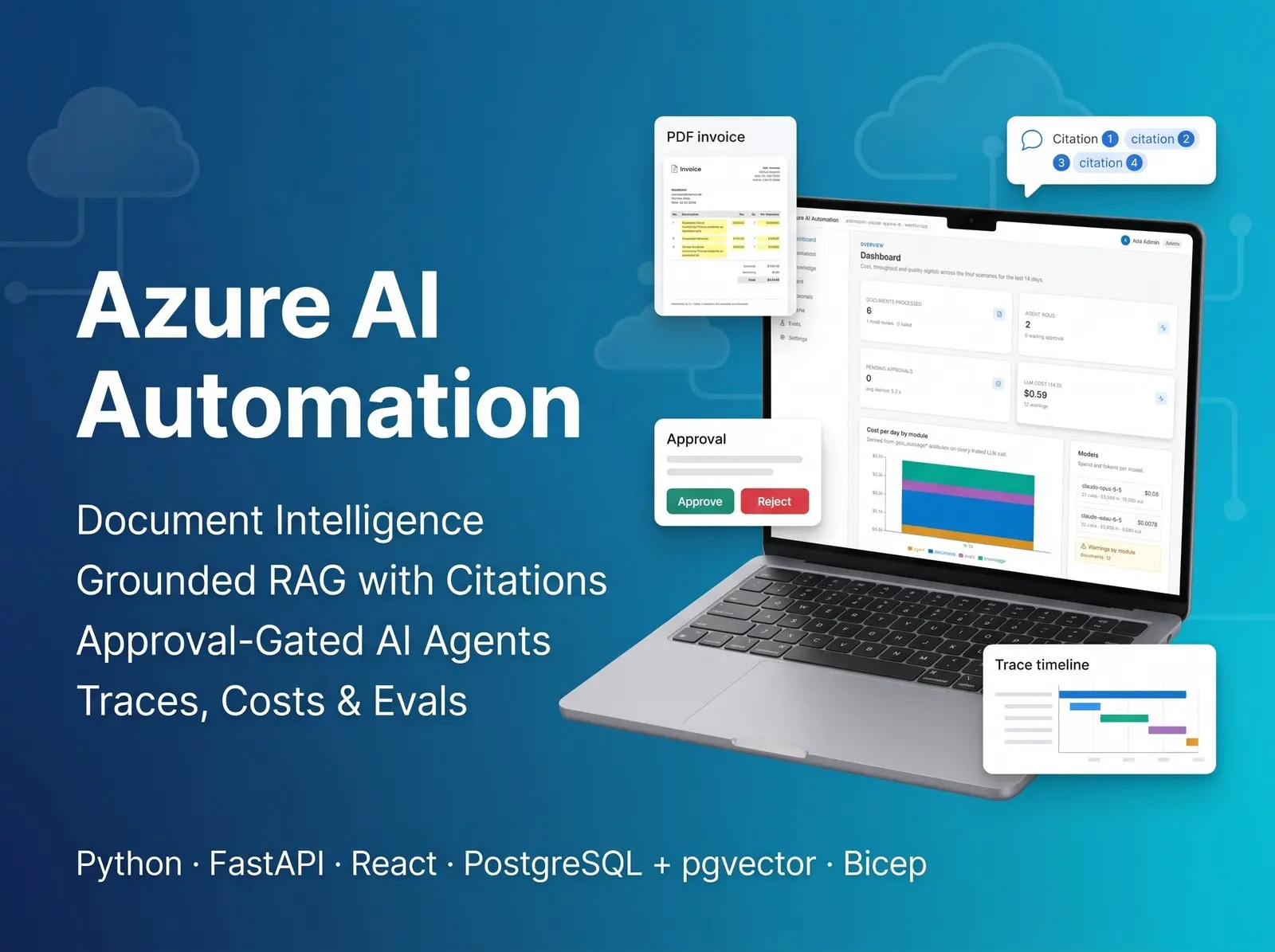
Azure AI Automation: Document Intelligence, RAG & Governed Agents
AI & Agents · Cloud, DevOps & LLMOps · Databases & Data Engineering
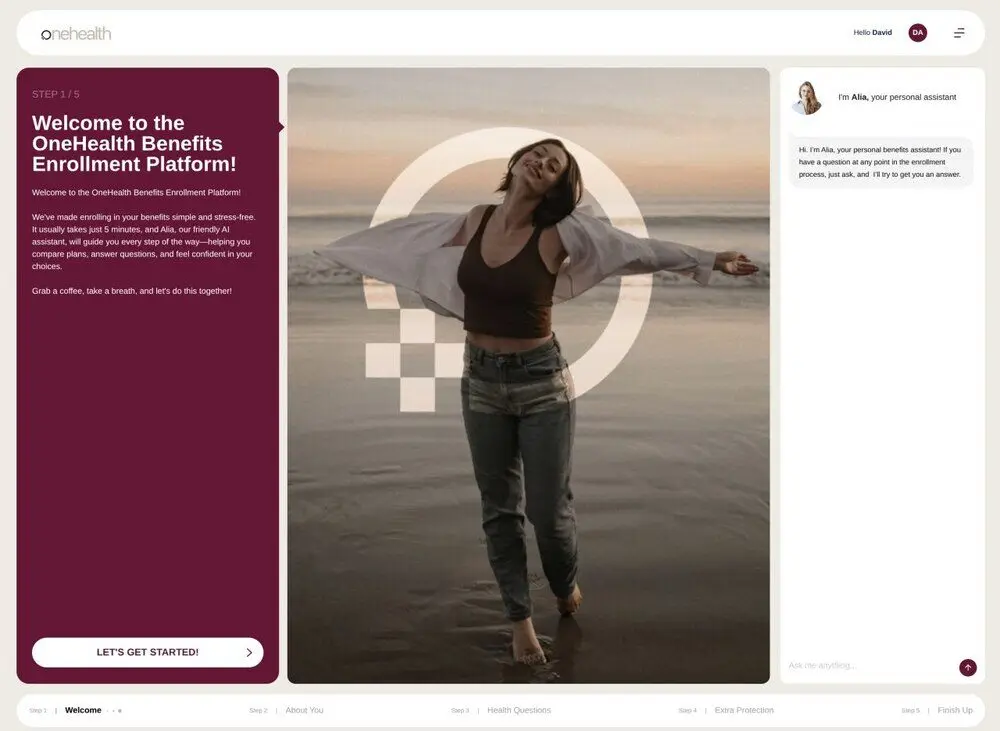
Virgil.ai: Agentic Health-Insurance Assistant
AI & Agents · AI ERP & SaaS · Cloud, DevOps & LLMOps · Security & Compliance